.png)
cage free aviary system
choice of markets
The aviary system is a new type of farming solution between cage free and free range farming, which is a compromise between the pursuit of commercial large scale farming and the fulfillment of animal welfare. Over the years, farmers have been striking a balance between pursuing large-scale commercial farming, improving the living environment of flocks, and complying with local farming policies. aviary system was born out of this demand. The aviary system provides a suitable living environment for the hens, increasing their activity level and thus improving egg production and egg quality, as the demand for healthy living standards increases.

why more and more people are
choosing our aviary system
comply with animal welfare-related policies
Aviary system needs a small investment compared with cage farming, because the cost of cage frames is lower. Compared with free-range farming, the space required is smaller.
Aviary systems can breed birds indoors while maximizing flock dynamics, satisfying the nature of the birds, and improving egg production and egg quality.
Reduce the occurrence and transmission of poultry diseases, lower the mortality rate of chickens, and improve immunity.
It is easy to manage, reduces the difficulty of egg collection, feeding, and manure removal, and can provide a good working environment for farmers.
aviary poultry system design and specification
The aviary system has spaces for birds to move around freely and the spaces are interconnected so that birds can move around freely in these spaces.
| Warranty period | 1 year |
| Weight (KG) | 60 |
| Showroom location | Egypt, Italy, Peru, Russia, Chile |
| Mechanical test report | Available |
| Core component warranty period | 1 year |
| Applicable industry | Farm |
| Dimensions | (5500+ 1150n)* 2500 2580mm |
| Base | 304 stainless steel |
| Top | 275g galvanized sheet |
| Per group | 1150mm, 2 sets of nesting boxes |
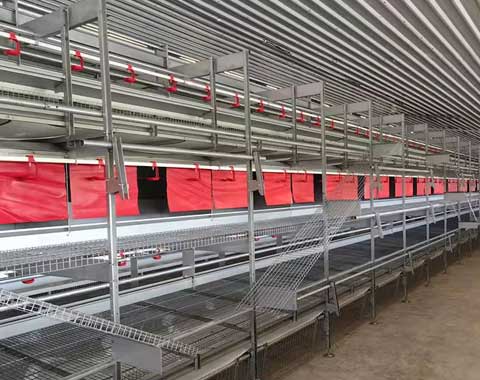
aviary system for commerical egg production
The aviary system consists of a number of ribs, which, in contrast to the traditional chicken cage, only retains the overall frame, which supports the cage and separates the spaces. In a way, the spatial hierarchy of the aviary system mimics the natural living environment, with stairs and approach platforms and tubes installed between these cage frames, allowing flocks to move more freely in them, even gliding, the natural behavior of the birds is stimulated. The aviary system is more often used in egg production than in broiler production, because it can greatly satisfy the egg collection needs of the farmers and improve the egg collection efficiency.


At the same time, aviary poultry systems follow the trend of scientific farming and are equipped with appropriate feeding systems, egg collection systems, temperature regulation systems and manure removal systems, etc., which are utilized to improve the overall efficiency while focusing on the welfare of the poultry.

Feeder and waterer for aviary poultry systems
For all large-scale commercial farms, automated feeding and watering is a priority, and this will certainly free up the labor of the farmer. In aviary systems, to satisfy the natural foraging behavior of hens and to reduce food waste, farmers usually choose feeders and waterers that require certain behavioral triggers, such as chain feeding systems spiral feeding systems, or traditional nipple waterers.

Not very different from the egg collector in commercial cage farms, the egg collecting machine for aviary poultry systems is mounted on the bottom of the cage frame with a slope and a soft mat to allow the eggs to fall into the egg collection area by gravity. If the demand for egg collection is high, an automatic egg collecting belt is necessary.

The manure removal system plays a role in the aviary system, which can remove the feces from the upper and lower layers of chickens in time, reduce the concentration of ammonia in the coop, ensure the air environment in the coop, and provide a safe and healthy environment for the laying hens to live in. According to the aviary system, the number of manure cleaning belts can be selected, and the width of the manure cleaning belt is generally between 1m and 2m.

Like the commercial cage model, if the temperature is not suitable for the survival of poultry in the area, the farmers usually choose indoor farming, so the lighting and ventilation system is also necessary. Proper lighting, temperature, and humidity not only affect the survival rate of the flock but also greatly affect the egg production rate and the quality of the eggs.